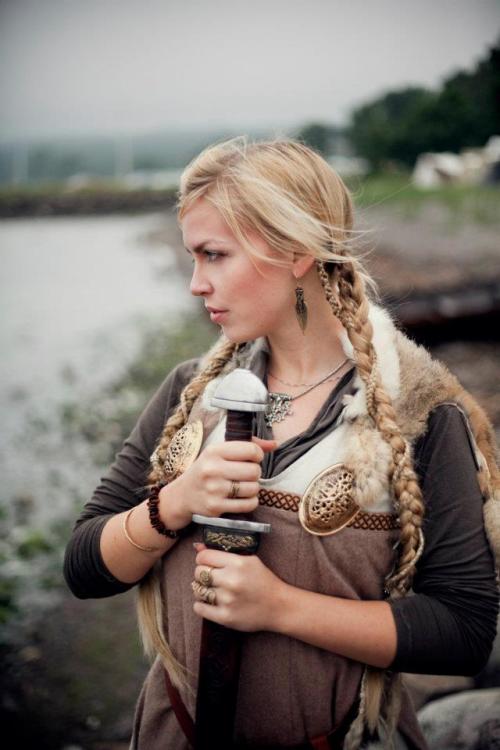
.
Showing posts with label Costume. Show all posts

Tuesday, 19 May 2020

Calm down about the Pipe Lady

A photo of an Anglo-Saxon skeleton skewered by a pipe has gone viral. But it’s not the scandal you’re looking for. 
Can we all please calm down about the pipe lady?

Recently a photo of an intact early Anglo-Saxon skeleton absolutely skewered by a modern cable or pipe, has gone viral. It’s a powerful photo emblematic of the trampling of heritage by modernity, and brutal disrespect of human remains. Except it isn’t.....

Early Anglo Saxon burial (Oakington, Cambs) bisected by modern utility pipe

Sunday, 13 October 2019

Men's Hairstyles

"Anglo-Saxon" and "Viking" Mens Hairstyles
Æd Thompson

"Criticise our haircuts one more time. I dare you..."
In our presentations we endeavour to create convincing and well-researched impressions of the dress and accoutrements of people of particular cultures, sub-periods (ideally century, half-century or even decade) and of particular status or societal role. Recently there has been a trend towards re-creation of assemblages from specific graves, though most such contexts fall well short of providing sufficient evidence on which to entirely base all details of costume, let alone other more ephemeral aspects of appearance.  

One such matter is that of hairstyle. We very frequently encounter individuals with very strong opinions on the matter of what hairstyles the people of late antiquity or early medieval period would have had, and are keen to point out how wrong we are, for our variously either “too modern” or “too clichéd” haircuts. Such criticism raises two questions; 
  • What do we really know about the hairstyles of nominally “Anglo-Saxon” and “Viking” period peoples?   
  • What is our group’s authenticity policy with respect to this issue?

In this article we hope to address both questions with respect to male hairstyle and grooming, with a further article on womens’ hair and head-wear to follow. 

Tuesday, 27 January 2015

Winingas / Leg Windings


Last year (2014) not long after we had arrived at West Stow Anglo-Saxon Village we learned of the death of an old friend; Roy Bickerstaffe, a long-standing fellow member of Þa Engliscan Gesiþas - the Anglo-Saxon Society, archery enthusiast and inspirational medievalist. A number of founding members of the Thegns had had many of their first experiences of living history with Roy, who's support and great knowledge had always been an inspiration.
Later that evening, as we sat around the hall-fire, wrapped in our cloaks, having eaten and drunk well, we toasted Roy’s memory, the person with whom we had shared much ale in the past.
I dedicate this article to his memory.


Winingas

Winingas are long strips of cloth which were wrapped around the lower legs. Also known as ‘leg bindings’, they are similar to the ‘puttees’ worn by British soldiers at the time of the Great War.
These items of clothing, although sometimes an annoyance for the modern living historian, have considerable utility, are almost ubiquitous on manuscript depictions of men during the Anglo-Saxon period, and are worth a brief study.


Image retrieved from Wikimedia Commons

___

Sunday, 31 March 2013

Shield-Maidens and Cross-Dressing

Shield Maidens and Cross-Dressing in Anglo-Saxon and Viking Times

Viking Warrior Queen. Unkown source*
Since the dawn of time, men have hunted and, armed with weapons, undertaken the task of warfare. Women gathered food from the land, had babies and stayed at home. By the time of the Migration Age, these stereotypical gender roles were well-established: the symbol for a male being the spear, while the symbol for a woman was the spindle. This distinction is essentially biologically rather than culturally based and across the world is true of virtually all societies, until the modern day. It was certainly true in early medieval England and Scandinavia for the vast majority of the population but the real situation may well have been more complex. Modern archaeology has uncovered grave evidence which challenges traditional assumptions about gender roles.

Migration Age graves from England, Scandinavia and the Low Countries have revealed men buried with traditionally female grave-goods and women found buried with weapons. What are we to make of this? Perhaps it is time to examine the evidence critically.

 *Image source unknown. Retrieved via tumblr.com under fair use.

Thursday, 3 January 2013

Arm Rings

Arm Rings; Bling or Bank-Account?

Increasingly, the image of wealthy or accomplished heroes from the Migration and 'Viking' ages is changing to include fine jewellery. Indeed, in Bernard Cornwell's popular "Saxon Stories" series, the protagonist Uhtred of Bebbanburg is described as wearing many glimmering arm-rings -prizes accumulated gradually during his career as a warrior. To what extent are such pieces of jewellery evidenced, and what purpose did they serve?

Conjectural golden arm-ring created by George Easton (danegeld.co.uk)

Saturday, 1 October 2011

Costume -Overview

The dress of Germanic people in the Migration-Age into the so-called 'Viking' period was the basis of later styles, but also had a number of aspects greatly influenced by earlier civilisations, or contemporary societies elsewhere in Europe and beyond. In particular, many styles were carried through from the Roman period.
Although fashions varied throughout the period, the general trend is the integration of older, conventional styles with new ideas arriving through extensive trade networks, or through natural progress on a more local level.