.
Showing posts with label Art. Show all posts

Sunday, 13 October 2019

Men's Hairstyles

"Anglo-Saxon" and "Viking" Mens Hairstyles
Æd Thompson

"Criticise our haircuts one more time. I dare you..."
In our presentations we endeavour to create convincing and well-researched impressions of the dress and accoutrements of people of particular cultures, sub-periods (ideally century, half-century or even decade) and of particular status or societal role. Recently there has been a trend towards re-creation of assemblages from specific graves, though most such contexts fall well short of providing sufficient evidence on which to entirely base all details of costume, let alone other more ephemeral aspects of appearance.  

One such matter is that of hairstyle. We very frequently encounter individuals with very strong opinions on the matter of what hairstyles the people of late antiquity or early medieval period would have had, and are keen to point out how wrong we are, for our variously either “too modern” or “too clichéd” haircuts. Such criticism raises two questions; 
  • What do we really know about the hairstyles of nominally “Anglo-Saxon” and “Viking” period peoples?   
  • What is our group’s authenticity policy with respect to this issue?

In this article we hope to address both questions with respect to male hairstyle and grooming, with a further article on womens’ hair and head-wear to follow. 

Monday, 3 April 2017

Art Styles - Part 3; Insular Art

Art of the Anglo-Saxon and Vikings -

                 Part 3: Insular Art

-Dr Andrew Thompson


In Part 1 of this series we discussed the rudimentary decorative styles which were used by craftspeople throughout the Migration Period and "Viking Age" to decorate everyday objects, while, in Part 2, we discussed the origins and evolution of animal style art (glossed as Salin Style I and II) which dominates the sophisticated archaeological material of the Early Anglo-Saxon period in Britain, and of contemporaneous Germanic tribes across North and western Europe.   

While this evolution of so-called "Germanic" art had been taking place, so-called "Celtic" art had continued to flourish and evolve, in a degree of isolation, in Ireland and the fringes of Britain. Cross-fertilisation of art between the "Germanic" world and the Hiberno/Celtic/Brythonic one appears to have been limited, following the Western Roman Collapse and on into the 7th century. However, as the elite of the emerging Anglo-Saxon kingdoms in Britain converted to Christianity in the 7th century, strongly under the influence of Irish missionaries, a new cultural bridge was formed between these two very different artistic cultures. The result, in the 8th century, would be some of the most spectacular art in European history...


Sunday, 19 February 2017

Art Styles - Part 2; Migration Animal Styles

Art of the Anglo-Saxon and Vikings -

     Part 2: Animal Styles of the Migration Period

-Dr Andrew Thompson 


In the previous chapter (link) we discussed a number of rudimentary decorative styles used throughout the Migration Period and Viking Ages by a range of north and western-European cultures. These styles represented efforts to personalize or embellish usually more every-day items, by non-elite craftspeople. In contrast, the more sophisticated art styles, used and developed by generations of elite, specialist artisans, have been the subject of more study. From the Migration Period through into the Viking Age, discussion of these sophisticated art styles is dominated by the so-called "animal styles", many of them quite abstract, which set apart the art of these periods from the more classical, or Romance artistic trends which dominated European fashions both before and after.

To some extent, these artistic styles were confined to particular crafts or materials, but by no means always, and while, for the sake of avoidance of embarrassing mistakes, many reenactor handbooks caution members against carrying decoration from one archaeological find to recreations in other materials, there is no doubt that extensive cross-fertilisation of artistic styles across different crafts and media did take place, especially moving into the Middle Anglo-Saxon period and Viking Ages.

This illustrated discussion of the various artistic styles of the period concerned, begins with the famous Animal Styles of the Migration Period. Springing principally from the material culture of southern Scandinavia and northern Germania during the late Iron Age, and the collision of their home-grown artistic styles with the prevalent decorative styles of the mid to late Roman Empire.  The fortunes of these artistic styles (themselves, at this time, almost exclusively focused on small portable, personal artworks and dress-items of metal and jewellery-work) would reflect the fortunes of the tribes who concieved them; flourishing, spreading, and diversifying, as the Western Roman Empire declined.  The styles which developed are so carefully applied, and distinct, that they can be used to confidently date archaeological finds.
As previously mentioned, it is not our intention, with this series, to advance the ever expanding, complex field of animal-art studies. For those wanting more authoritative, detailed analysis and discussion we recommend the references included at the end of each chapter. However, we hope that this series provides an accessible, entertaining and intelligible tour of the art these historic periods have to offer.
With the scene set, and taking a deep breath, let us dive into the typology of Migration-Age animal art.... 

Monday, 13 February 2017

Art Styles - Part 1

Art of the Anglo-Saxon and Vikings -

     Part 1: Introduction, and Rudimentary Decoration

-Dr Andrew Thompson


It is clear that the creation of art is one of the defining characteristics of humanity, and civilization. In its strictest sense ‘art’ refers to works made with the intention of being aesthetically pleasing rather than serving any other function, however, a broader definition would include the decoration of functional objects such as tools (what might now be referred to as “arts and crafts”), and the majority of works of ‘art’ from Northern Europe during the what we in England call the 'Anglo-Saxon' and 'Viking' periods would fall into this latter category.

In this context, decoration may have served to personalise objects, or have even greater significance - perhaps serving as an emblem for a particular group identity, or serve as a focus for story-telling, much as stained-glass windows did in later medieval churches. The Anglo-Saxons, 'Vikings' and associated Northern European cultures in this period seem to have enjoyed stories, riddles and puzzles, and it may be that their artwork often had a layer of meaning that would be easy for them to tease out, but is extremely difficult for us, who are not steeped in their mythology.

For those studying, or (like us) hoping to recreate the material culture of these peoples, a broad, working understanding of their art styles is arguably essential. To that end it is hoped this series of articles, containing annotated summaries of the broad artistic styles of these cultures and periods, will be useful.

Saturday, 26 March 2016

Shields: How small is too small?

Shields: How small is too small?


 Few, or perhaps no items of personal warrior gear are more important to our image of an Anglo-Saxon, or Viking warrior than the shield. Our understanding of this most essential piece of war-gear is informed, to some extent by pictoral depictions and written references, but, mainly, by patchy but nonetheless reliable inferences from cemetery archaeology.

Of the studies of Anglo-Saxon shields, arguably the most frequently cited, and informative, is Dickinson and Härke (1992) which, among other issues, seeks to shed light on the murky subject of shield size. Many readers, particularly those from the reenactment community, will be surprised to read that shields could often be as small as 34cm – certainly of no use for building interlocking 'shield-walls' described in later poetry, which we are led to believe was the dominant combat strategy as far back as the period of pagan burials.

Over 20 years on from the publication of this still critically important work, this observation has gradually exerted influence on some modern impressions of warriors from the period, and even beyond, given the limited evidence for late Anglo-Saxon shields, and limited availability of information on 'Viking' ones. It is further, not uncommon to hear, repeated by respected historians, the assertion that most early Anglo-Saxon shields were “little more than bucklers”. To what extent is this statement accurate? Just how small were Anglo-Saxon shields?

Thursday, 3 January 2013

Arm Rings

Arm Rings; Bling or Bank-Account?

Increasingly, the image of wealthy or accomplished heroes from the Migration and 'Viking' ages is changing to include fine jewellery. Indeed, in Bernard Cornwell's popular "Saxon Stories" series, the protagonist Uhtred of Bebbanburg is described as wearing many glimmering arm-rings -prizes accumulated gradually during his career as a warrior. To what extent are such pieces of jewellery evidenced, and what purpose did they serve?

Conjectural golden arm-ring created by George Easton (danegeld.co.uk)

Sunday, 25 November 2012

Anglo-Saxon Scabbard Bosses

Anglo-Saxon Scabbard Bosses

In the Migration Age, swords indicated high status and personal wealth, and were worth protecting. Though extant remains of scabbards are rare (largely organic, only surviving under rare conditions) it is beyond doubt that all swords would've had a sheath.
It stands to reason that sheaths would also be used to display status, yet eye-catching metallic fittings are relatively rare in the archaeological record. Of course, our ancestors' love for recycling must bear its portion of the blame for this, and we know that, in many cases, Anglo-Saxon sword sheaths would've been decorated using foundation-moulding and leather-tooling, and by application of finely woven coloured braids instead. However, one example of quintessentially Anglo-Saxon metallic scabbard decoration from the 7th Century may have been much more common than has previously been supposed...

Monday, 12 November 2012

Dragon

The English Dragon

The wingéd, fire-breathing dragon is a particularly English Monster, typified by those slain in Medieval stories such as “St.George and the Dragon”. The story of the evolution of this creature, so well described by Tolkien, in “The Hobbit” is a fascinating one...


Tuesday, 14 August 2012

Læwatan: Staffs Hoard Seax 2


Læwatan; a Wælseax inspired by the Staffordshire Hoard     -Part 2

With the Seax now complete, attention could be given to the sheath that would protect it, and the selection of a suitable name. The sheath, as much as the seax itself, provided an opportunity to showcase the evolution of Anglo-Saxon artistic styles, while the name opens discussion of language and mythology.  

Saturday, 16 June 2012

The Hög Edsten Pommelcap

In discussion of one of the oldest items in the Staffordshire Hoard - k711, it is impossible not to mention the Hög Edsten sword pommel-cap. A little-known Scandinavian find from pre-Viking west Sweden, the Hög Edsten pommel-cap shares the antipodal boar motif seen on 711, and has been described as the most beautiful intact execution of migration-period Germanic gold-and-garnet cloisonne work on a pommel-cap in the archaeological record.

The beauty of this piece is undeniable, but why is it so little-known, and in light of more recent discoveries, what stories can this piece tell us?

Thursday, 17 May 2012

STH 711

Sth711: Woden's Pommelcap

 Much attention has been given to the glittering gold and garnet work of the Staffordshire Hoard, but often, plainer items can be much more informative.
sth711 (nicknamed 'Dave' by conservators) is a fine example of this, foregoing gemstones in favour of fascinating images in cast relief.

What are the meanings of these images, and what can they tell us about the history of this piece, the hoard itself, and the people who buried it?

Nb. Observations herein are based on photographs and are intended to encourage debate. It is likely many of these observations have already been made by the team of conservators and historians working on the hoard, but given that, so far, little detailed analysis has been published for public perusal, hopefully this article will help encourage public interest in close analysis of the finds. 
 © Images in this article have been used with the kind permission of Birmingham Museums and are subject to strict copyright (1)

Sunday, 15 April 2012

The Boar


Animals feature significantly in early Germanic art and culture, often carrying a mythological or totemic connection to deities. So far in our series of articles on animals the importance of the raven, bear, and wolf have been discussed, but arguably the most significant animal to feature in finds from the Anglo-Saxon and Viking period is the boar.

In this article, the cultural significance of the boar, its history, etymology, and role in mythology is discussed. 

Thursday, 15 March 2012

The Raven

According to Norse Mythology, Óðinn All-föðr had in his service two ravens, whose names were were Huginn (Thought) and Muninn (Memory). Everyday they would fly around Miðgarðr in search of information. At the end of their journey across the world, they would perch on his shoulders and whisper into his ears all that they had seen and heard.
With its striking blue-black plumage, the Raven was a potent symbol to the folk of North-West Europe, and depictions of these animals can be found on many artifacts. In this article, the significance of the Raven is discussed.

Saturday, 18 February 2012

The Franks Casket; Summary

Oftentimes, archaeological finds out-of-context may not be especially informative. However, there are exceptions, not least the Franks Casket. Perhaps the most culturally significant artefact to be uncovered from the Migration Period, this small box (22.9 cm long, 19 cm wide and 10.9 cm high) fashioned from whale-bone and deeply carved on all sides with Christian, Pagan and even Roman imagery, has helped shape our understanding of Anglo-Saxon culture, mythology, technology, and their “place in the world”.

An expert on the casket, Dr Alfred Becker has written a short introduction on the box for us, with his thoughts on this fascinating object. An ocean of additional analysis and discussion of the Casket can be found at http://www.franks-casket.de/ .

Thursday, 26 January 2012

Golden Helmet of the Staffordshire Hoard?

The discovery of the Staffordshire Hoard in the parish of Hammerwich in the heart of Mercia in 2009 was an extremely exciting time; never before had so many, ornate finds from the Anglo-Saxon period been found. The mysterious context of the finds encouraged public fascination, but my own personal interest was focused on one item; k453, the largest item in the hoard; something that must surely have been the shining golden cheekpiece of the most ornate helmet that had ever been.

We quickly visited the hoard on two occasions, obtained measurements and tried to come up with a means of incorporating such a cheek-piece into helmet designs of the age, to put together a working hypothesis of what this most magnificent of helmets could have looked like.
This article lays out some thoughts on piece K453, and the 5th Anglo-Saxon helm to be discovered.

Tuesday, 17 January 2012

The Chessell Down Scabbard Mount

In the 19th Century an Anglo-Saxon cemetry, Chessell Down on the Isle of Wight was excavated, and yielded a number of interesting artefacts. Most fascinating amongst them, arguably, a decorative silver fitting from an ornate sword-sheath, continues to mystify scholars today.

Monday, 7 November 2011

Did Anglo-Saxons use crystal lenses?

Visby lens, 11th century
Anglo-Saxon jewelry such as seen in the Staffordshire Hoard and Sutton-Hoo burial is of astonishing intricacy. It has always been a mystery how such fine work - both gold filigree and garnet cloisonné - could have been achieved without modern aids.
For example;  each corrugated reflective gold foil underlying each tiny cut garnet is between 0.01 - 0.25 mm thick and the waffle-like corrugations on their surface are often 5½ to the millimeter. The garnets themselves are often very thin, between 0.5 - 0.75 mm and only about 2mm x 2mm across.
How could the Anglo-Saxons have been capable of crafting such minute detail, hundreds of years before the first glass lenses were invented?

Friday, 14 October 2011

The Stag on the Sceptre

Sutton-Hoo Sceptre
Animal imagery is common amongst early Germanic artefacts, particularly from the Pagan period. Often such imagery is associated with the gods, and is believed to have often been included on items such as helmets (especially Anglo-Saxon examples) to provide the wearer with that god's protection. Boars, dragons and serpents are particularly common, but occasionally, items arise with imagery that is not so familiar.

Amongst the royal East-Anglan treasure of Sutton-Hoo, however, was a curious item unique amongst Anglo-Saxon finds; a 1/2 meter tall whetstone sceptre, with finely-carved faces at the ends and the twisted-wire ring on which stands the figure of a stag cast in bronze.This is nicely modelled, complete with a realistic set of antlers.
    Why a stag ?

Tuesday, 11 October 2011

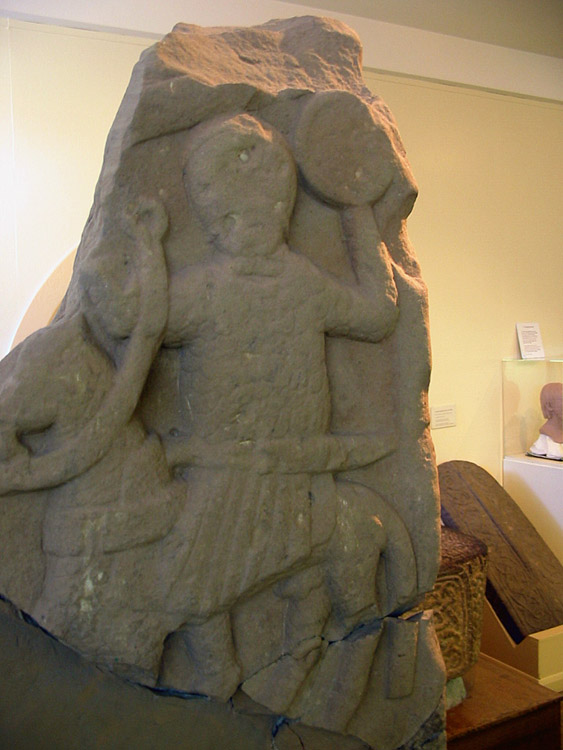
The Repton Warrior (Saxon scale armour?)

The Repton Warrior
  This fragment of sculpture, discovered in 1979, is thought to have been part of the shaft of a cross or other memorial. It may well represent Æþelbald, who was Anglo-Saxon King of Mercia from 716 to 757 and who termed himself “Rex Britanniae”. He was eventually murdered by his own bodyguard and interred in the crypt at Repton’s monastic church. Interpretation of the stylised image supports established ideas about dress in this period, but calls other conventional ideas about the period into question.