.
Showing posts with label Armour. Show all posts

Saturday, 16 May 2020

There are FIVE Anglo-Saxon Helmets

Only five helmets; and the Staffordshire Helm isnt one of them. -------------------
 Opinion: There are FIVE Anglo-Saxon Helmets (and the Staffordshire Helm isn’t one of them) 
- A corpus review & quibbling rant by Æd Thompson


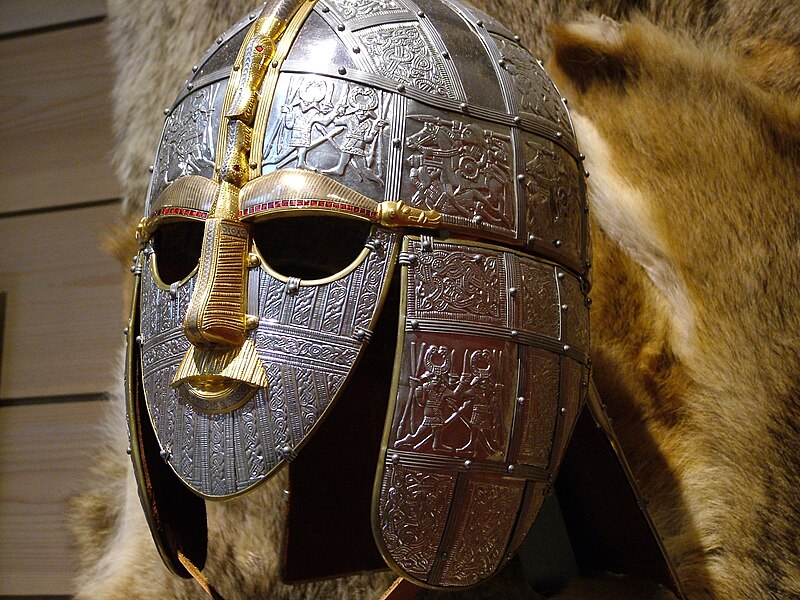
Sutton Hoo Helmet (reconstr.) - Wikimedia Commons
Few archaeological finds are as evocative as helmets - many items of war-gear can help paint a picture of ancient battlefields, but in framing (or in some cases directly representing) the face, helmets help to humanise warriors from centuries past. This is particularly ironic given that, at least in some cases, helmets in antiquity were designed to create an intimidating sense of “otherness”, occupying the “uncanny valley” between metalwork and man. It is in our nature to recognise and emotionally respond to faces, and it is hard to stare into the eyes of the Sutton Hoo helmet and not feel as though you have, in some sense, met a person, rather than simply viewed an archaeological artefact. No surprise then, that over and above all the other treasures in that unprecedented burial panoply (including some with considerably higher bullion value) it is the helmet from Sutton Hoo that has become emblematic of the assemblage, and the most enduring symbol both of Anglo-Saxon material culture, and even of British history itself.

The Anglo-Saxon period in Britain spanned six centuries, and although it is unfairly reductive to characterise it purely as a time of war, it is undoubtedly true that regular clashes between well-equipped armies peppered the period and dictated the convoluted path taken from locally identifying post-Roman communities to a coherent united England. The scale of Anglo-Saxon armies continues to be debated, and it is not entirely clear how well equipped they were, but archaeological discoveries in recent decades have provided abundant examples of war-gear – especially weapons – to inform our image of Anglo-Saxon warriors. Such gear is most abundant from the early period (5-7th centuries) thanks to grave goods from the ultimately doomed furnished-burial rite, but even from these centuries, that most evocative item of war-gear, the helmet, is exquisitely rare. We just don’t have many examples. There’s a bigger problem though; we don’t even know how many examples we have. Almost all running totals are wrong.

________________________________________

Saturday, 26 March 2016

Shields: How small is too small?

Shields: How small is too small?


 Few, or perhaps no items of personal warrior gear are more important to our image of an Anglo-Saxon, or Viking warrior than the shield. Our understanding of this most essential piece of war-gear is informed, to some extent by pictoral depictions and written references, but, mainly, by patchy but nonetheless reliable inferences from cemetery archaeology.

Of the studies of Anglo-Saxon shields, arguably the most frequently cited, and informative, is Dickinson and Härke (1992) which, among other issues, seeks to shed light on the murky subject of shield size. Many readers, particularly those from the reenactment community, will be surprised to read that shields could often be as small as 34cm – certainly of no use for building interlocking 'shield-walls' described in later poetry, which we are led to believe was the dominant combat strategy as far back as the period of pagan burials.

Over 20 years on from the publication of this still critically important work, this observation has gradually exerted influence on some modern impressions of warriors from the period, and even beyond, given the limited evidence for late Anglo-Saxon shields, and limited availability of information on 'Viking' ones. It is further, not uncommon to hear, repeated by respected historians, the assertion that most early Anglo-Saxon shields were “little more than bucklers”. To what extent is this statement accurate? Just how small were Anglo-Saxon shields?

Tuesday, 29 July 2014

The Shield from Bidford-on-Avon Grave 182 (2/2)

The Shield from Bidford-on-Avon Grave 182  (Part 2) 

Bidford-182 boss  (with permission of Shakespeare Birthplace Trust)
In the previous article we discussed the importance of the early Anglian cemetery of Bidford-on-Avon and the unique shield remains found in in a warrior grave known as grave-182, excavated in 1923. While this mixed-burial-rite cemetery has yielded many impressive finds (mostly dated to the 6th and early 7th centuries) the grave-182 shield remains are of huge interest and have few comparisons.

 Following two years of research, acquisition of materials, and after personal examination of the finds (kindly facilitated by the Shakespeare Birthplace Trust Collections Dept.), we attempted to produce a convincing reconstruction of what this high-status shield may have originally looked like, using authentic materials and techniques.
The result, we hope, will help shed new light on and raise awareness of the long forgotten find, allow the story of the find to be told, and allow greater appreciation of the skilled craftspeople who built the original.

Nb. we are greatly indebted to the Shakespeare Birthplace Trust Collections Department, without who's help we could not have pieced together the story of the find. Examination of the original fragments in spring 2014, in particular, was crucial to achieving a representative reconstruction. 

Sunday, 20 July 2014

The Shield from Bidford-on-Avon Grave 182 (1/2)

The Shield from Bidford-on-Avon Grave 182  (Part 1) 

While some of the Early Anglo-Saxon kingdoms have yielded much archaeology, and continue to yield extensive cemeteries and settlement sites for study, others are arguably less well served. The ancient kingdom of Mercia - of particular interest to our group, could in many ways be seen as such a case, and this presents a particular challenge when attempting to recreate the effects of this purportedly powerful, wealthy and sophisticated culture. Beyond the Staffordshire Hoard (itself mostly belonging to the mid-late 7th century and containing a very selective subset of items), at a glance one might be forgiven for thinking the Midlands lacked much in the way of early Anglo-Saxon archaeology.

In fact, there are a handful of archaeological sites which have yielded impressive finds, which are relevant to the earliest times of the Mercian kingdom - it is just that many were excavated in the early days of Anglo-Saxon archaeology, and their finds forgotten, lost, or hidden from view.

One such case; the large cemetery of Bidford-upon-Avon, Warwickshire, initially excavated between 1923 and 1924 (Humphreys et. al., 1925) sheds valuable light on early Anglo-Saxon Mercia and has yielded many impressive finds, including a great quantity of feminine items of decidedly Anglian (rather than Saxon) affinities, including one of the most impressive square-headed brooches ever found. Among a number of warrior graves, the most impressive item, however, was a shield-boss decorated in such a way as to make it entirely exceptional, artistically, and of a status (within the British Isles) second perhaps only to the kingly shield of Sutton-Hoo Mound 1.

The impressive shield-boss from Bidford-on-Avon grave 182 is not on public display, residing with the Shakespeare Birthplace Trust. To raise awareness of this find and explore what this piece of warrior gear may have looked like in its day, in 2012 we embarked on a lengthy process to reconstruct the shield, using authentic materials and techniques.

Nb. we are greatly indebted to the Shakespeare Birthplace Trust Collections Department, without who's help we could not have pieced together the story of the find. Examination of the original fragments in spring 2014, in particular, was crucial to achieving a representative reconstruction. 

Sunday, 1 September 2013

The Wollaston / Pioneer Helm

The Wollaston Helm (se bárhelm fram Wulfafes tun)

In March 1997, an Anglo-Saxon helmet was unearthed by archaeologists in a gravel-quarry at Wollaston in Eastern Northamptonshire. This was very exciting, as only three other helmets from this period were known to exist; the kingly Sutton-Hoo helm, the Coppergate helm from York and the Benty-Grange helm from Derbyshire. Immediately on hearing the news we visited Leicester Museum, where a temporary exhibition had been put on. There I found myself rubbing shoulders with a number of experts on early English battle-gear and took copious notes, planning a reconstruction as soon as possible.

Compared to the splendour of the reconstructed Sutton-Hoo helm or the virtually intact magnificence of the ‘Coppergate’, the so-called ‘Pioneer Helm’ was underwhelming, being plain and functional. Only half had survived the plough; the back section and one side having been destroyed. Still, there was enough left to reconstruct and over the next few weeks, a replica of sorts was produced. It has to be said that I disliked the thing from the beginning and have never taken it out of the dark recesses of its cabinet.
Recently, however, we acquired another replica, this time made by Tim Noyes of Heron Armoury (heronarmoury.co.uk). His version is, to my eyes, much more aesthetically pleasing and while it will never be as beautiful as its kingly contemporaries, is worthy of respect as a functional piece of armour. It is thus worth while examining what was probably the most common type of iron helmet in Early Anglo-Saxon England.

Monday, 21 January 2013

Anglo-Saxon and "Viking" Helmets and Helmet Words

Helmets, and Helmet Words
Replica of the Sutton-Hoo Mound-1 Helm


The magnificent Sutton-Hoo helmet remains one of the most memorable and evocative symbols of the Anglo-Saxon Age; an age when many still worshipped the Old Gods of battle and death. Along with the splendid helms of pre-Viking Vendel Sweden, the Anglo-Saxon war-helms provide a unique insight into the mindset of our ancestors, and it is interesting to examine the terms our ancestors used for helmets and their components. 
In this article, the form and function of Migration and Viking-Age Helmets are discussed, with reference to the most notable finds, alongside an examination of the Old English and Old Norse words used to describe them.

Sunday, 6 January 2013

Anglo-Saxon and Viking Shield Words

Anglo-Saxon and "Viking" Shield Words 

The mark of the true warrior in Germanic society, strangely enough, was not the life-taking spear but the life-protecting shield. Warriors fought in the shield-wall and the worst disgrace was to lose one’s shield on the field of battle. As Spartan mothers had told their sons a thousand years earlier:
"Either (with) it (your shield), or on it"
Modern warriors have replaced the spear and the sword but our riot-police still use shields and shield-tactics which would be quite familiar to the Anglo-Saxon or Norse warrior.
To a large extent, the English and Norse names for the parts of a shield have been forgotten, even by historians. In this article I hope to shed some light on the names used by our ancestors for their shields, and their parts.

Thursday, 6 December 2012

Finally an English Spangenhelm (Shorwell)

Finally an English Spangenhelm

Recently a new Anglo-Saxon helmet has come to light. It is presently being reconstructed by the British Museum. It was acquired way back in 2006 but was originally thought to be an iron cooking pot (as was the late-Roman Burgh Castle helm!). To be fair, the helmet is in numerous small fragments but it appears to be a so-called ‘spangenhelm’ dating to the 6th century CE and comparable with numerous examples from continental Europe. Other than some fragments of gold foil found in Dumfriesshire which just may be part of the brow-band of a spangenhelm, evidence for the use of this common type of Migration-Age helmet in Britain has been lacking until now. It is thus well worth while reviewing this type of helmet.

Friday, 2 March 2012

Vikings Fact or Fiction 2

Horned Helmets

There used to be a story that there were three types of Viking re-enactors : those with plain helmets, those with helmets with horns stuck to them and those who turned up to battle with helmets with two brown circles of old glue!
It is still a reasonably popular misconception that the Scandinavian warriors that terrorized Europe between the 8th and 12th Centuries CE had iron head-gear sprouting either horns or wings. Such is the hold of this idea on the popular imagination that it was incorporated into Stan Lee's comics, and even in the recent Thor movie gods such as Odinn, Heimdal and Loki were equipped with horned helms and Thor himself has silver wings sweeping up from the cheek-pieces of his helmet...

Thursday, 26 January 2012

Golden Helmet of the Staffordshire Hoard?

The discovery of the Staffordshire Hoard in the parish of Hammerwich in the heart of Mercia in 2009 was an extremely exciting time; never before had so many, ornate finds from the Anglo-Saxon period been found. The mysterious context of the finds encouraged public fascination, but my own personal interest was focused on one item; k453, the largest item in the hoard; something that must surely have been the shining golden cheekpiece of the most ornate helmet that had ever been.

We quickly visited the hoard on two occasions, obtained measurements and tried to come up with a means of incorporating such a cheek-piece into helmet designs of the age, to put together a working hypothesis of what this most magnificent of helmets could have looked like.
This article lays out some thoughts on piece K453, and the 5th Anglo-Saxon helm to be discovered.

Sunday, 22 January 2012

Splinted Armour


Valsgarde-8

Migration-Era Splinted Armour; The Fact and the Fiction

In the late 19th / early 20th Century, the excavation of Grave 8 at Valsgärde in Uppland, Sweden, (dated to between 635-650 CE.) revealed a lavishly furnished ship grave of a Migration-Age warrior. The grave goods included a splendid helmet, equestrian equipment, mail and a set of splint-armour. No other examples of this kind of armour had been found before or since in Western Europe; how was this equipment worn?

Wednesday, 9 November 2011

Viking Boat Burial in Scotland; thoughts

An intact Viking boat burial has been recently excavated at Port an Eilean Mhòir on the remote Scottish peninsula of Ardnamurchan.

The soil conditions have long since eroded away most of the boat’s timbers and all but the teeth and a few bone fragments but, just as at Sutton-Hoo, the outline of the boat is preserved as a soil shadow lined by rows of rusted ships rivets... 

Tuesday, 11 October 2011

The Repton Warrior (Saxon scale armour?)

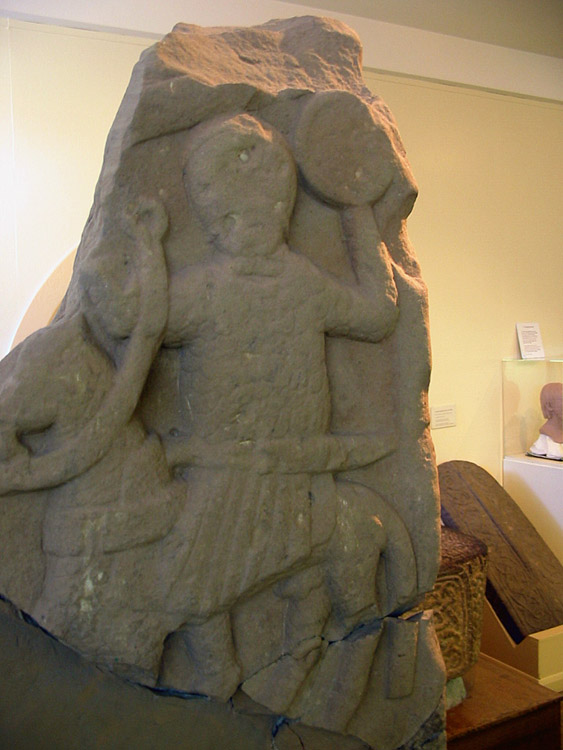
The Repton Warrior
  This fragment of sculpture, discovered in 1979, is thought to have been part of the shaft of a cross or other memorial. It may well represent Æþelbald, who was Anglo-Saxon King of Mercia from 716 to 757 and who termed himself “Rex Britanniae”. He was eventually murdered by his own bodyguard and interred in the crypt at Repton’s monastic church. Interpretation of the stylised image supports established ideas about dress in this period, but calls other conventional ideas about the period into question.


Friday, 7 October 2011

Armour and Shields -Overview

Typical Early Germanic Warrior
Personal protective equipment of some kind would've been crucial to the survival of any warrior or soldier on a battlefield before the introduction of firearms, such as those fighting in Anglo-Saxon, Viking or Norman battles.

Faced primarily by stabbing and slashing weapons, the armour of the Middle Ages was descended from earlier technology and was by no means primitive. Indeed, on modern battlefields where firearms are banished; urban riots, the equipment used by police closely resembles and is descended from technology from the Roman period and Middle Ages.