.
Showing posts with label Sutton-Hoo. Show all posts

Saturday, 16 May 2020

There are FIVE Anglo-Saxon Helmets

Only five helmets; and the Staffordshire Helm isnt one of them. -------------------
 Opinion: There are FIVE Anglo-Saxon Helmets (and the Staffordshire Helm isn’t one of them) 
- A corpus review & quibbling rant by Æd Thompson


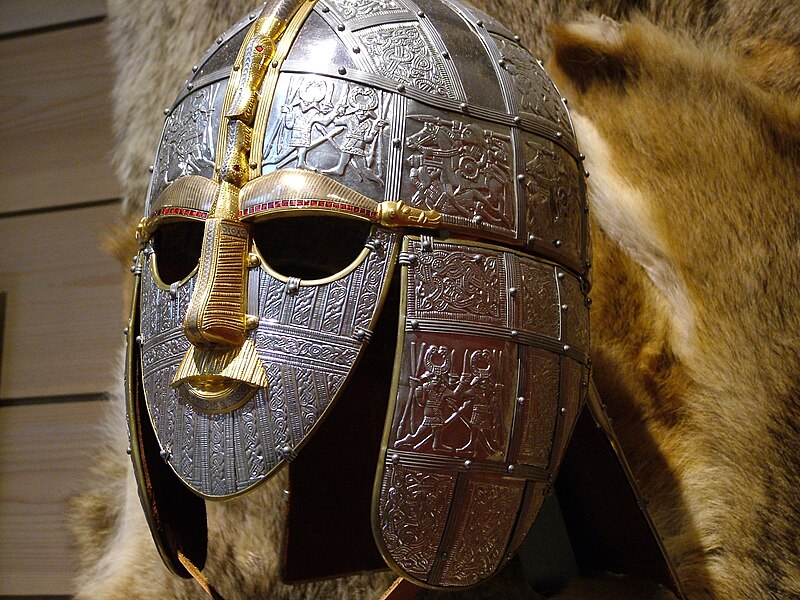
Sutton Hoo Helmet (reconstr.) - Wikimedia Commons
Few archaeological finds are as evocative as helmets - many items of war-gear can help paint a picture of ancient battlefields, but in framing (or in some cases directly representing) the face, helmets help to humanise warriors from centuries past. This is particularly ironic given that, at least in some cases, helmets in antiquity were designed to create an intimidating sense of “otherness”, occupying the “uncanny valley” between metalwork and man. It is in our nature to recognise and emotionally respond to faces, and it is hard to stare into the eyes of the Sutton Hoo helmet and not feel as though you have, in some sense, met a person, rather than simply viewed an archaeological artefact. No surprise then, that over and above all the other treasures in that unprecedented burial panoply (including some with considerably higher bullion value) it is the helmet from Sutton Hoo that has become emblematic of the assemblage, and the most enduring symbol both of Anglo-Saxon material culture, and even of British history itself.

The Anglo-Saxon period in Britain spanned six centuries, and although it is unfairly reductive to characterise it purely as a time of war, it is undoubtedly true that regular clashes between well-equipped armies peppered the period and dictated the convoluted path taken from locally identifying post-Roman communities to a coherent united England. The scale of Anglo-Saxon armies continues to be debated, and it is not entirely clear how well equipped they were, but archaeological discoveries in recent decades have provided abundant examples of war-gear – especially weapons – to inform our image of Anglo-Saxon warriors. Such gear is most abundant from the early period (5-7th centuries) thanks to grave goods from the ultimately doomed furnished-burial rite, but even from these centuries, that most evocative item of war-gear, the helmet, is exquisitely rare. We just don’t have many examples. There’s a bigger problem though; we don’t even know how many examples we have. Almost all running totals are wrong.

________________________________________

Sunday, 19 February 2017

Art Styles - Part 2; Migration Animal Styles

Art of the Anglo-Saxon and Vikings -

     Part 2: Animal Styles of the Migration Period

-Dr Andrew Thompson 


In the previous chapter (link) we discussed a number of rudimentary decorative styles used throughout the Migration Period and Viking Ages by a range of north and western-European cultures. These styles represented efforts to personalize or embellish usually more every-day items, by non-elite craftspeople. In contrast, the more sophisticated art styles, used and developed by generations of elite, specialist artisans, have been the subject of more study. From the Migration Period through into the Viking Age, discussion of these sophisticated art styles is dominated by the so-called "animal styles", many of them quite abstract, which set apart the art of these periods from the more classical, or Romance artistic trends which dominated European fashions both before and after.

To some extent, these artistic styles were confined to particular crafts or materials, but by no means always, and while, for the sake of avoidance of embarrassing mistakes, many reenactor handbooks caution members against carrying decoration from one archaeological find to recreations in other materials, there is no doubt that extensive cross-fertilisation of artistic styles across different crafts and media did take place, especially moving into the Middle Anglo-Saxon period and Viking Ages.

This illustrated discussion of the various artistic styles of the period concerned, begins with the famous Animal Styles of the Migration Period. Springing principally from the material culture of southern Scandinavia and northern Germania during the late Iron Age, and the collision of their home-grown artistic styles with the prevalent decorative styles of the mid to late Roman Empire.  The fortunes of these artistic styles (themselves, at this time, almost exclusively focused on small portable, personal artworks and dress-items of metal and jewellery-work) would reflect the fortunes of the tribes who concieved them; flourishing, spreading, and diversifying, as the Western Roman Empire declined.  The styles which developed are so carefully applied, and distinct, that they can be used to confidently date archaeological finds.
As previously mentioned, it is not our intention, with this series, to advance the ever expanding, complex field of animal-art studies. For those wanting more authoritative, detailed analysis and discussion we recommend the references included at the end of each chapter. However, we hope that this series provides an accessible, entertaining and intelligible tour of the art these historic periods have to offer.
With the scene set, and taking a deep breath, let us dive into the typology of Migration-Age animal art.... 

Saturday, 26 March 2016

Shields: How small is too small?

Shields: How small is too small?


 Few, or perhaps no items of personal warrior gear are more important to our image of an Anglo-Saxon, or Viking warrior than the shield. Our understanding of this most essential piece of war-gear is informed, to some extent by pictoral depictions and written references, but, mainly, by patchy but nonetheless reliable inferences from cemetery archaeology.

Of the studies of Anglo-Saxon shields, arguably the most frequently cited, and informative, is Dickinson and Härke (1992) which, among other issues, seeks to shed light on the murky subject of shield size. Many readers, particularly those from the reenactment community, will be surprised to read that shields could often be as small as 34cm – certainly of no use for building interlocking 'shield-walls' described in later poetry, which we are led to believe was the dominant combat strategy as far back as the period of pagan burials.

Over 20 years on from the publication of this still critically important work, this observation has gradually exerted influence on some modern impressions of warriors from the period, and even beyond, given the limited evidence for late Anglo-Saxon shields, and limited availability of information on 'Viking' ones. It is further, not uncommon to hear, repeated by respected historians, the assertion that most early Anglo-Saxon shields were “little more than bucklers”. To what extent is this statement accurate? Just how small were Anglo-Saxon shields?

Monday, 21 January 2013

Anglo-Saxon and "Viking" Helmets and Helmet Words

Helmets, and Helmet Words
Replica of the Sutton-Hoo Mound-1 Helm


The magnificent Sutton-Hoo helmet remains one of the most memorable and evocative symbols of the Anglo-Saxon Age; an age when many still worshipped the Old Gods of battle and death. Along with the splendid helms of pre-Viking Vendel Sweden, the Anglo-Saxon war-helms provide a unique insight into the mindset of our ancestors, and it is interesting to examine the terms our ancestors used for helmets and their components. 
In this article, the form and function of Migration and Viking-Age Helmets are discussed, with reference to the most notable finds, alongside an examination of the Old English and Old Norse words used to describe them.

Sunday, 6 January 2013

Anglo-Saxon and Viking Shield Words

Anglo-Saxon and "Viking" Shield Words 

The mark of the true warrior in Germanic society, strangely enough, was not the life-taking spear but the life-protecting shield. Warriors fought in the shield-wall and the worst disgrace was to lose one’s shield on the field of battle. As Spartan mothers had told their sons a thousand years earlier:
"Either (with) it (your shield), or on it"
Modern warriors have replaced the spear and the sword but our riot-police still use shields and shield-tactics which would be quite familiar to the Anglo-Saxon or Norse warrior.
To a large extent, the English and Norse names for the parts of a shield have been forgotten, even by historians. In this article I hope to shed some light on the names used by our ancestors for their shields, and their parts.

Sunday, 25 November 2012

Anglo-Saxon Scabbard Bosses

Anglo-Saxon Scabbard Bosses

In the Migration Age, swords indicated high status and personal wealth, and were worth protecting. Though extant remains of scabbards are rare (largely organic, only surviving under rare conditions) it is beyond doubt that all swords would've had a sheath.
It stands to reason that sheaths would also be used to display status, yet eye-catching metallic fittings are relatively rare in the archaeological record. Of course, our ancestors' love for recycling must bear its portion of the blame for this, and we know that, in many cases, Anglo-Saxon sword sheaths would've been decorated using foundation-moulding and leather-tooling, and by application of finely woven coloured braids instead. However, one example of quintessentially Anglo-Saxon metallic scabbard decoration from the 7th Century may have been much more common than has previously been supposed...

Tuesday, 20 November 2012

Sutton-Hoo Axe-Hammer

The Sutton-Hoo Axe-Hammer

One of the most enigmatic items found in 1939 in Mound 1 at Sutton Hoo was a large axe-hammer forged entirely from iron. To this day, mystery surrounds this unique object: is it a weapon, or something else?


Monday, 12 November 2012

Dragon

The English Dragon

The wingéd, fire-breathing dragon is a particularly English Monster, typified by those slain in Medieval stories such as “St.George and the Dragon”. The story of the evolution of this creature, so well described by Tolkien, in “The Hobbit” is a fascinating one...


Sunday, 14 October 2012

Drinking Horns

Taplow Horns
Anglo-Saxon and Viking Drinking Horns

A drinking-horn (dryncehorn) is a drinking vessel made from a cow-horn. In a society with limited access to decent pottery, such a drinking vessel is a cheap and easily available alternative to expensive metal. However, large drinking horns are strongly associated with the æðeling (princely) class, often decorated with gold and silver. Rituals involving the communal sharing of drink from a large horn were part of the glue which maintained early Anglo-Saxon society. The Dryncehorn is worthy of study.

Friday, 11 May 2012

The Deer

The Deer : “Home is where the Hart is !”

CC Bill Ebesen
Heorot, meaning "Hall of the Hart" was the name given by King Hroðgar of Denmark to his great Mead-Hall. The Anglo-Saxon epic poem describes how the hero Beowulf comes to destroy the monster Grendel who has been plaguing Heorot. Was Heorot decorated with the antlers of a great red deer ? We shall never know but the stag had some considerable ritual significance to our ancestors. The famous Sutton-Hoo whetstone (click here) carries a terminal in the shape of a stag and stags are said to browse on the leaves of the World Tree in Norse Mythology.
In this article, the cultural significance of the deer, its history, etymology, and role in mythology is discussed.

Sunday, 15 April 2012

The Boar


Animals feature significantly in early Germanic art and culture, often carrying a mythological or totemic connection to deities. So far in our series of articles on animals the importance of the raven, bear, and wolf have been discussed, but arguably the most significant animal to feature in finds from the Anglo-Saxon and Viking period is the boar.

In this article, the cultural significance of the boar, its history, etymology, and role in mythology is discussed. 

Monday, 7 November 2011

Did Anglo-Saxons use crystal lenses?

Visby lens, 11th century
Anglo-Saxon jewelry such as seen in the Staffordshire Hoard and Sutton-Hoo burial is of astonishing intricacy. It has always been a mystery how such fine work - both gold filigree and garnet cloisonné - could have been achieved without modern aids.
For example;  each corrugated reflective gold foil underlying each tiny cut garnet is between 0.01 - 0.25 mm thick and the waffle-like corrugations on their surface are often 5½ to the millimeter. The garnets themselves are often very thin, between 0.5 - 0.75 mm and only about 2mm x 2mm across.
How could the Anglo-Saxons have been capable of crafting such minute detail, hundreds of years before the first glass lenses were invented?

Friday, 14 October 2011

The Stag on the Sceptre

Sutton-Hoo Sceptre
Animal imagery is common amongst early Germanic artefacts, particularly from the Pagan period. Often such imagery is associated with the gods, and is believed to have often been included on items such as helmets (especially Anglo-Saxon examples) to provide the wearer with that god's protection. Boars, dragons and serpents are particularly common, but occasionally, items arise with imagery that is not so familiar.

Amongst the royal East-Anglan treasure of Sutton-Hoo, however, was a curious item unique amongst Anglo-Saxon finds; a 1/2 meter tall whetstone sceptre, with finely-carved faces at the ends and the twisted-wire ring on which stands the figure of a stag cast in bronze.This is nicely modelled, complete with a realistic set of antlers.
    Why a stag ?

Wednesday, 12 October 2011

Music

Whilst the history of the academic study  and theory of music can only, at a stretch, be traced back as far as the Medieval period, enjoyment of music can be traced back as far as Prehistory.
Generic replica bone-flutes
The oldest true instrument; a 5-holed flute fashioned from a vulture bone, discovered in Germany, dates back 35,000 years. This find, and fragments of others made of Mammoth ivory, is proof that the history of music goes back as far as the Paleolithic, and it is, perhaps, telling of the difficulty of uncovering evidence of the music of ancient peoples, that although the history of music spans the last 35,000 years, the music of our ancestors only 1500 years ago remains shrouded in mystery.

Friday, 7 October 2011

Armour and Shields -Overview

Typical Early Germanic Warrior
Personal protective equipment of some kind would've been crucial to the survival of any warrior or soldier on a battlefield before the introduction of firearms, such as those fighting in Anglo-Saxon, Viking or Norman battles.

Faced primarily by stabbing and slashing weapons, the armour of the Middle Ages was descended from earlier technology and was by no means primitive. Indeed, on modern battlefields where firearms are banished; urban riots, the equipment used by police closely resembles and is descended from technology from the Roman period and Middle Ages.