.
Showing posts with label Viking. Show all posts

Sunday, 13 October 2019

Men's Hairstyles

"Anglo-Saxon" and "Viking" Mens Hairstyles
Æd Thompson

"Criticise our haircuts one more time. I dare you..."
In our presentations we endeavour to create convincing and well-researched impressions of the dress and accoutrements of people of particular cultures, sub-periods (ideally century, half-century or even decade) and of particular status or societal role. Recently there has been a trend towards re-creation of assemblages from specific graves, though most such contexts fall well short of providing sufficient evidence on which to entirely base all details of costume, let alone other more ephemeral aspects of appearance.  

One such matter is that of hairstyle. We very frequently encounter individuals with very strong opinions on the matter of what hairstyles the people of late antiquity or early medieval period would have had, and are keen to point out how wrong we are, for our variously either “too modern” or “too clichéd” haircuts. Such criticism raises two questions; 
  • What do we really know about the hairstyles of nominally “Anglo-Saxon” and “Viking” period peoples?   
  • What is our group’s authenticity policy with respect to this issue?

In this article we hope to address both questions with respect to male hairstyle and grooming, with a further article on womens’ hair and head-wear to follow. 

Monday, 13 February 2017

Art Styles - Part 1

Art of the Anglo-Saxon and Vikings -

     Part 1: Introduction, and Rudimentary Decoration

-Dr Andrew Thompson


It is clear that the creation of art is one of the defining characteristics of humanity, and civilization. In its strictest sense ‘art’ refers to works made with the intention of being aesthetically pleasing rather than serving any other function, however, a broader definition would include the decoration of functional objects such as tools (what might now be referred to as “arts and crafts”), and the majority of works of ‘art’ from Northern Europe during the what we in England call the 'Anglo-Saxon' and 'Viking' periods would fall into this latter category.

In this context, decoration may have served to personalise objects, or have even greater significance - perhaps serving as an emblem for a particular group identity, or serve as a focus for story-telling, much as stained-glass windows did in later medieval churches. The Anglo-Saxons, 'Vikings' and associated Northern European cultures in this period seem to have enjoyed stories, riddles and puzzles, and it may be that their artwork often had a layer of meaning that would be easy for them to tease out, but is extremely difficult for us, who are not steeped in their mythology.

For those studying, or (like us) hoping to recreate the material culture of these peoples, a broad, working understanding of their art styles is arguably essential. To that end it is hoped this series of articles, containing annotated summaries of the broad artistic styles of these cultures and periods, will be useful.

Saturday, 26 March 2016

Shields: How small is too small?

Shields: How small is too small?


 Few, or perhaps no items of personal warrior gear are more important to our image of an Anglo-Saxon, or Viking warrior than the shield. Our understanding of this most essential piece of war-gear is informed, to some extent by pictoral depictions and written references, but, mainly, by patchy but nonetheless reliable inferences from cemetery archaeology.

Of the studies of Anglo-Saxon shields, arguably the most frequently cited, and informative, is Dickinson and Härke (1992) which, among other issues, seeks to shed light on the murky subject of shield size. Many readers, particularly those from the reenactment community, will be surprised to read that shields could often be as small as 34cm – certainly of no use for building interlocking 'shield-walls' described in later poetry, which we are led to believe was the dominant combat strategy as far back as the period of pagan burials.

Over 20 years on from the publication of this still critically important work, this observation has gradually exerted influence on some modern impressions of warriors from the period, and even beyond, given the limited evidence for late Anglo-Saxon shields, and limited availability of information on 'Viking' ones. It is further, not uncommon to hear, repeated by respected historians, the assertion that most early Anglo-Saxon shields were “little more than bucklers”. To what extent is this statement accurate? Just how small were Anglo-Saxon shields?

Friday, 28 August 2015

Fire (1 /2)

Fire  (1/2)

Fire has played a hugely important role in the lives of human beings since prehistory. Though the importance of fires for providing essential warmth, and facilitating cooking is both obvious and difficult to overstate, the almost ubiquitous social practice of gathering around a fire was likely crucial to the forming of social bonds within early communities.   As anyone who has wild-camped, or spent a dark night in a reconstructed hall will tell you, the dancing flames of a hearth fire often have the miraculous effect of  banishing discomfort, creating wellbeing, and bringing people together.
Yet fire can also turn against us; burn, kill, or swallow homes and settlements whole. Fire is an essential yet treacherous friend, and, for this reason, our relationship with fire has always been a complicated one.

Given the importance of fires for life, and community, and taking into account its treacherous nature, the study of historic cultures' relationships with fire is particularly fascinating. How did our ancestors view fire? How did they make it? And to what extent did they understand the mechanisms which underpin this essential tool?

In this series we examine the techniques likely used by the Anglo-Saxons and "Vikings" to make fire and the evidence for them, and discuss snippets of mythology pertaining to fire which give us glimpses of these cultures' understanding. We, further, present some findings from our own experiments with historic fire-making using widely available, forage-able materials.


Sunday, 5 January 2014

Wyrd / Fate

Modern statues of the Nornir at Ribe, Dk.
Wyrd

 The concept of an all-powerful Fate or Destiny is fundamental, not only to the Anglo-Saxon world view but of Indo-European philosophy generally.
The word ‘wyrd’ occurs no less than nine times in Beowulf, where it is used to denote ‘omnipotent fate or destiny’, and its use reveals much about Anglo-Saxon beliefs. The Anglo-Saxon understanding of 'wyrd', and the related but subtly different Norse equivalent is worth discussing.

Monday, 8 April 2013

Size Matters

Size Matters

A perennial statement we hear from members of the public, is the belief that folk long ago we smaller than we are today. Most are very surprised to learn that our Anglo-Saxon and Scandinavian ancestors were no smaller than us and that some of the warrior class were tall and strong, even by today's standard. In the light of this it is worth briefly examining how we are so certain of this fact and why there is such a widespread misconception regarding stature.

Sunday, 31 March 2013

Shield-Maidens and Cross-Dressing

Shield Maidens and Cross-Dressing in Anglo-Saxon and Viking Times

Viking Warrior Queen. Unkown source*
Since the dawn of time, men have hunted and, armed with weapons, undertaken the task of warfare. Women gathered food from the land, had babies and stayed at home. By the time of the Migration Age, these stereotypical gender roles were well-established: the symbol for a male being the spear, while the symbol for a woman was the spindle. This distinction is essentially biologically rather than culturally based and across the world is true of virtually all societies, until the modern day. It was certainly true in early medieval England and Scandinavia for the vast majority of the population but the real situation may well have been more complex. Modern archaeology has uncovered grave evidence which challenges traditional assumptions about gender roles.

Migration Age graves from England, Scandinavia and the Low Countries have revealed men buried with traditionally female grave-goods and women found buried with weapons. What are we to make of this? Perhaps it is time to examine the evidence critically.

 *Image source unknown. Retrieved via tumblr.com under fair use.

Monday, 21 January 2013

Anglo-Saxon and "Viking" Helmets and Helmet Words

Helmets, and Helmet Words
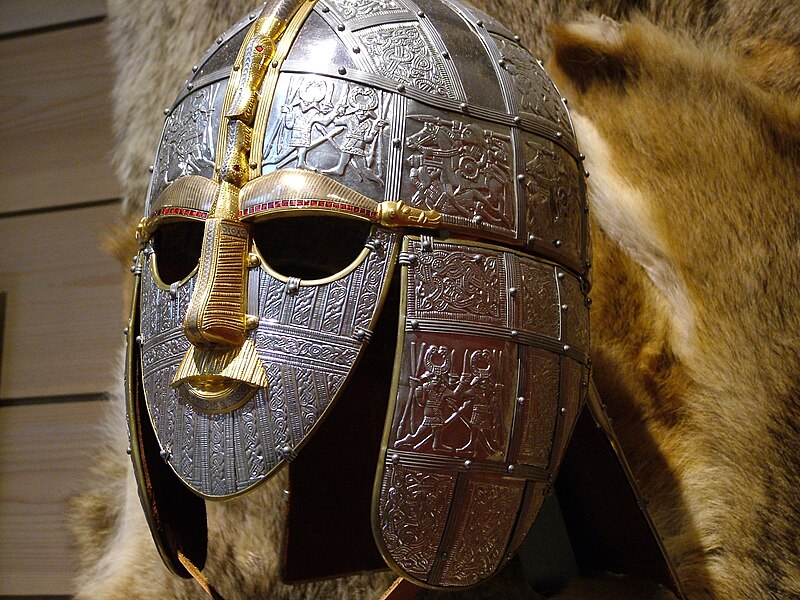
Replica of the Sutton-Hoo Mound-1 Helm


The magnificent Sutton-Hoo helmet remains one of the most memorable and evocative symbols of the Anglo-Saxon Age; an age when many still worshipped the Old Gods of battle and death. Along with the splendid helms of pre-Viking Vendel Sweden, the Anglo-Saxon war-helms provide a unique insight into the mindset of our ancestors, and it is interesting to examine the terms our ancestors used for helmets and their components. 
In this article, the form and function of Migration and Viking-Age Helmets are discussed, with reference to the most notable finds, alongside an examination of the Old English and Old Norse words used to describe them.

Sunday, 6 January 2013

Anglo-Saxon and Viking Shield Words

Anglo-Saxon and "Viking" Shield Words 

The mark of the true warrior in Germanic society, strangely enough, was not the life-taking spear but the life-protecting shield. Warriors fought in the shield-wall and the worst disgrace was to lose one’s shield on the field of battle. As Spartan mothers had told their sons a thousand years earlier:
"Either (with) it (your shield), or on it"
Modern warriors have replaced the spear and the sword but our riot-police still use shields and shield-tactics which would be quite familiar to the Anglo-Saxon or Norse warrior.
To a large extent, the English and Norse names for the parts of a shield have been forgotten, even by historians. In this article I hope to shed some light on the names used by our ancestors for their shields, and their parts.

Thursday, 3 January 2013

Arm Rings

Arm Rings; Bling or Bank-Account?

Increasingly, the image of wealthy or accomplished heroes from the Migration and 'Viking' ages is changing to include fine jewellery. Indeed, in Bernard Cornwell's popular "Saxon Stories" series, the protagonist Uhtred of Bebbanburg is described as wearing many glimmering arm-rings -prizes accumulated gradually during his career as a warrior. To what extent are such pieces of jewellery evidenced, and what purpose did they serve?

Conjectural golden arm-ring created by George Easton (danegeld.co.uk)

Thursday, 29 November 2012

The Single-Edged Viking Sword


The Single-Edged Viking Sword

While most Viking-Age swords are of the classic straight two-edged design, about 20% of those found in Norway are single-edged (Geibig XIV). These weapons cannot really be classified as long-saxes as they had orthodox sword-hilts. Single edged Viking swords were still in use at the end of the 9th C and early 10th C. Their nearest Medieval equivalents would be the Falchion and the großes Messer. An interesting weapon, the single-edged sword is worthy of study.
Berserkr by Albion Armouries, Single-edged Viking Sword (wikimedia commons)

Monday, 12 November 2012

Dragon

The English Dragon

The wingéd, fire-breathing dragon is a particularly English Monster, typified by those slain in Medieval stories such as “St.George and the Dragon”. The story of the evolution of this creature, so well described by Tolkien, in “The Hobbit” is a fascinating one...


Wednesday, 30 May 2012

Viking Ships 1

Ladby Ship
Viking and pre-Viking Ships, and their impact upon the Western World -Part 1


In this series of articles, Viking and pre-Viking ships are compared, and their historical significance and impact upon the western world are discussed. With particular reference to such finds as the Heberby, Nydam, Skuldelev, Gokstad and Ladby ships, it is hoped that this series of articles will bring a number of threads together to give a comprehensive overview of this topic.

Sunday, 25 March 2012

Berserkers 2: Theories

Berserkers: Theories

In a previous article the history and significance of the fearsome Viking berserkers were discussed. The characteristic trance-like battle-rage of the berserkers deserves special attention. 

As a medical doctor with experience in psychiatry and pharmacology, one question springs immediately to my mind; if berserkers really existsed, how was such a state (the berserkergang) achieved?

Thursday, 22 March 2012

Berserkers 1: Overview

Berserkers: An overview

The Berserkers (or berserks) were Norse warriors who are reported in the Old Norse literature to have fought in a nearly uncontrollable, trance-like fury, which gave rise to the Modern English word berserk. Berserkers are attested in several Old Norse sources. Most historians believe that berserkers worked themselves into a rage before battle, but some think that they might have utilised drugs or alcohol to achieve this state.

Friday, 9 March 2012

Vikings: Fact or Fiction 3

Double-Bladed Axes


The common caricature-Viking is depicted with a horned helmet and swinging an enormous double-bladed axe. Unfortunately, there is even less evidence for the double-bitted battle-axe in the Viking Period than the horned helmet...

Friday, 2 March 2012

Vikings Fact or Fiction 2

Horned Helmets

There used to be a story that there were three types of Viking re-enactors : those with plain helmets, those with helmets with horns stuck to them and those who turned up to battle with helmets with two brown circles of old glue!
It is still a reasonably popular misconception that the Scandinavian warriors that terrorized Europe between the 8th and 12th Centuries CE had iron head-gear sprouting either horns or wings. Such is the hold of this idea on the popular imagination that it was incorporated into Stan Lee's comics, and even in the recent Thor movie gods such as Odinn, Heimdal and Loki were equipped with horned helms and Thor himself has silver wings sweeping up from the cheek-pieces of his helmet...

Friday, 24 February 2012

Vikings Fact or Fiction 1

Skull Cups

It is a popular idea that Vikings used the skulls of their enemies as drinking vessels. This is not inconceivable, for there is good evidence that this has happened since the dawn of mankind.
A skull cup is a drinking vessel made from an inverted human brain-case that has had the remainder of the skull cut away. The use of human skulls as a drinking cups in ritual use or as trophies is recorded in sources throughout history and among various peoples. Among Indo-European cultures this is most often associated with the nomadic cultures of the Eurasian steppe.
Is there evidence this persisted through to the Viking period, and if not, where did this idea come from?

Saturday, 28 January 2012

Late Anglo-Saxon and "Viking" Swords

The Gilling Sword (C 9th) **

From the late 8th Century C.E. the Anglo-Saxon and Scandinavian sword began to change. The parallel-sided broad blade became less common and the more tapering style of blade more common. Simultaneously, there was a move away from the composite metal / organic hilts of the Migration towards simpler, and possibly more robust, solid iron hilts and pommels. Many of these English swords had a downward curved lower guard and an upward curved pommel-guard suggesting a more dynamic cut and thrust style of sword-play.

With particular reference to the elegant Petersen Type L sword, it is worth discussing their form and function.

**image (right) property of Vintagedept@flickr

Tuesday, 13 December 2011

Other Viking Weapon Words (Vápnorðar)


Type-A Viking Axe (*Paul Binns)

So far, with Viking Sword Words we have discussed the fascinating Norse terminology used to describe the items that were, for many members of this warlike people, their prized possession. There were many other key tools in the Viking arsenal though, and here, the terms for these are discussed.