.
Showing posts with label Language. Show all posts

Friday, 28 August 2015

Fire (1 /2)

Fire  (1/2)

Fire has played a hugely important role in the lives of human beings since prehistory. Though the importance of fires for providing essential warmth, and facilitating cooking is both obvious and difficult to overstate, the almost ubiquitous social practice of gathering around a fire was likely crucial to the forming of social bonds within early communities.   As anyone who has wild-camped, or spent a dark night in a reconstructed hall will tell you, the dancing flames of a hearth fire often have the miraculous effect of  banishing discomfort, creating wellbeing, and bringing people together.
Yet fire can also turn against us; burn, kill, or swallow homes and settlements whole. Fire is an essential yet treacherous friend, and, for this reason, our relationship with fire has always been a complicated one.

Given the importance of fires for life, and community, and taking into account its treacherous nature, the study of historic cultures' relationships with fire is particularly fascinating. How did our ancestors view fire? How did they make it? And to what extent did they understand the mechanisms which underpin this essential tool?

In this series we examine the techniques likely used by the Anglo-Saxons and "Vikings" to make fire and the evidence for them, and discuss snippets of mythology pertaining to fire which give us glimpses of these cultures' understanding. We, further, present some findings from our own experiments with historic fire-making using widely available, forage-able materials.


Saturday, 31 May 2014

Tolkien's Beowulf translation - review

Cover (reproduced under fair-dealing; criticism and review)

“Beowulf: A Translation and Commentary by J.R.R. Tolkien” 

A Review by Dr A.J. Thompson

This book (available here) has been eagerly awaited by both Tolkien fans and Anglo-Saxonists alike. For the most part it was written in the 1920’s but was never intended for publication; In fact the scholarly and obsessively perfectionist professor later wrote to a friend lamenting the fact that the translation was ‘in much, hardly to my liking’. It has taken much work by Christopher Tolkien to get it into a state where it was fit to be published. 

Given the importance of the Beowulf text to our understanding of the language, beliefs, culture and worldview of the early English, and given Tolkien's almost legendary reputation as a scholar of Old English, the publishing of this book is an important milestone, and the text itself is very much worth examining and discussing. 
Having recently received a copy of the newly published book I thought I might jot down some thoughts on my impression of it, which hopefully may be useful to anyone unsure about whether to buy it. Please do note that the opinions expressed here are my own...

Saturday, 8 February 2014

The Anglo-Saxon Sword Riddles

The Anglo-Saxon Sword Riddles

Anglo-Saxon swords were not merely death-dealing weapons, ‘wigena weorðmynd’ (“joy of warriors” (Beowulf 1559) but potent symbols of leadership, social status and ancestral lineage. Oaths of fealty and maybe even marriage vows were sworn on the sword, probably to invoke the power of the sword-god Tiw, who protected the sanctity of oaths.

The 10th Century Exeter Book contains numerous Anglo-Saxon Riddles; two of which clearly have a sword as the solution. In her seminal book on the Anglo-Saxon sword, HR Ellis Davidson discusses the sword-riddles in some detail. In light of new discoveries; particularly that of the Staffordshire Hoard, the Sword Riddles are well worth re-examining.

Sunday, 5 January 2014

Wyrd / Fate

Modern statues of the Nornir at Ribe, Dk.
Wyrd

 The concept of an all-powerful Fate or Destiny is fundamental, not only to the Anglo-Saxon world view but of Indo-European philosophy generally.
The word ‘wyrd’ occurs no less than nine times in Beowulf, where it is used to denote ‘omnipotent fate or destiny’, and its use reveals much about Anglo-Saxon beliefs. The Anglo-Saxon understanding of 'wyrd', and the related but subtly different Norse equivalent is worth discussing.

Sunday, 24 March 2013

Daroð - Light Javelin

Daroð -  The Light Javelin

In an earlier article concerning spears, I wrote that the javelin could be thought of as a light spear meant to be thrown as a missile weapon. While the already discussed 'Angon' heavy javelin fell out of use by the later period, lighter javelins seem to have seen longer use. The Old English name for such a weapon was "daroð", from which the modern term ‘dart’ derives. Such a universal weapon deserves a more in-depth review.

Tuesday, 29 January 2013

Combs and Lice

Combs and Lice in the Anglo-Saxon Age

Today, for most in the developed world, ectoparasites are a thing of the past. In fact, the war on lice was only relatively recently won. In other species, such parasites are significantly detrimental to individual fitness, but human beings and, to a lesser extent, other primates, have demonstrated a unique ability to rid ourselves of such irritations. Much of the progress made by man has followed from one humble and ancient invention; the comb - an object that, by the Anglo-Saxon period, was in extensive use. The manufacture of Anglo-Saxon combs appears to have been quite a complex process, emphasising the importance of such objects, and it is worthwhile examining the significance of this tool in Anglo-Saxon society, along with other strategies used by our 'Dark-Age' ancestors for tackling infestation.

Monday, 21 January 2013

Anglo-Saxon and "Viking" Helmets and Helmet Words

Helmets, and Helmet Words
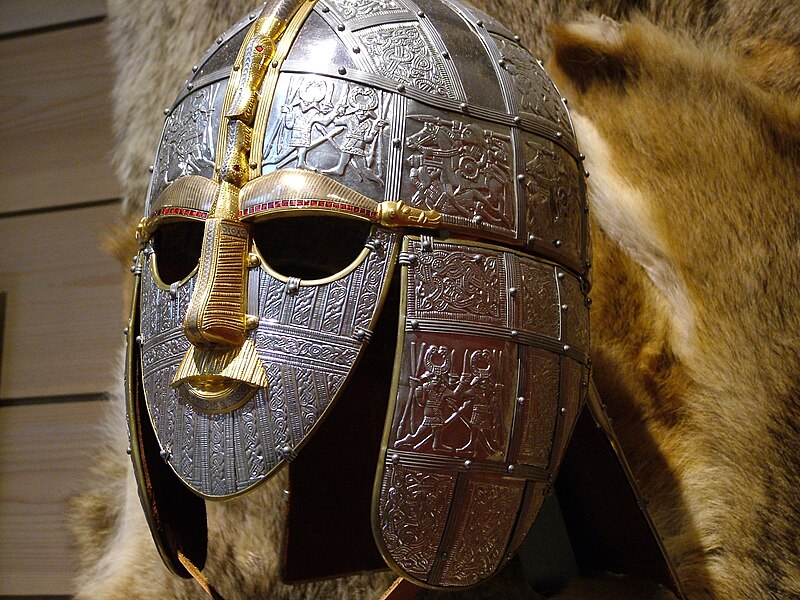
Replica of the Sutton-Hoo Mound-1 Helm


The magnificent Sutton-Hoo helmet remains one of the most memorable and evocative symbols of the Anglo-Saxon Age; an age when many still worshipped the Old Gods of battle and death. Along with the splendid helms of pre-Viking Vendel Sweden, the Anglo-Saxon war-helms provide a unique insight into the mindset of our ancestors, and it is interesting to examine the terms our ancestors used for helmets and their components. 
In this article, the form and function of Migration and Viking-Age Helmets are discussed, with reference to the most notable finds, alongside an examination of the Old English and Old Norse words used to describe them.

Sunday, 6 January 2013

Anglo-Saxon and Viking Shield Words

Anglo-Saxon and "Viking" Shield Words 

The mark of the true warrior in Germanic society, strangely enough, was not the life-taking spear but the life-protecting shield. Warriors fought in the shield-wall and the worst disgrace was to lose one’s shield on the field of battle. As Spartan mothers had told their sons a thousand years earlier:
"Either (with) it (your shield), or on it"
Modern warriors have replaced the spear and the sword but our riot-police still use shields and shield-tactics which would be quite familiar to the Anglo-Saxon or Norse warrior.
To a large extent, the English and Norse names for the parts of a shield have been forgotten, even by historians. In this article I hope to shed some light on the names used by our ancestors for their shields, and their parts.

Tuesday, 4 December 2012

Mead

Mead

Mead, a drink produced from fermented honey-water, is one of the oldest alcoholic drinks, possibly even pre-dating farming. It was a favourite beverage in Northern Europe where the climate is not suitable for viniculture. Mead had ritual and spiritual significance for the Anglo-Saxon and Vikings, and deserves discussion.

Monday, 12 November 2012

Dragon

The English Dragon

The wingéd, fire-breathing dragon is a particularly English Monster, typified by those slain in Medieval stories such as “St.George and the Dragon”. The story of the evolution of this creature, so well described by Tolkien, in “The Hobbit” is a fascinating one...


Thursday, 11 October 2012

The Dog


 The Dog

The dog (Canis lupus familiaris) has been the premier companion-species to man for many millennia. The wolf (Canis lupus) would seem to have been tamed roughly 15,000 years ago. Dogs act as guard-animals, aid in hunting and act as companions.
Dogs were much valued in early English and Scandinavian society...

Friday, 11 May 2012

The Deer

The Deer : “Home is where the Hart is !”

CC Bill Ebesen
Heorot, meaning "Hall of the Hart" was the name given by King Hroðgar of Denmark to his great Mead-Hall. The Anglo-Saxon epic poem describes how the hero Beowulf comes to destroy the monster Grendel who has been plaguing Heorot. Was Heorot decorated with the antlers of a great red deer ? We shall never know but the stag had some considerable ritual significance to our ancestors. The famous Sutton-Hoo whetstone (click here) carries a terminal in the shape of a stag and stags are said to browse on the leaves of the World Tree in Norse Mythology.
In this article, the cultural significance of the deer, its history, etymology, and role in mythology is discussed.

Tuesday, 24 April 2012

The Horse


“Hwær cwom mearg? Hwær cwom mago?”
Where is the horse gone? Where the rider? (The Wanderer)

Both Anglo-Saxon and Scandinavian warriors, particularly nobles, loved their horses. They might prefer to fight on foot, swinging sword or axe with their men (unlike the Normans) but to own a horse meant status, rather like owning an expensive car does today. A king might direct a battle from the saddle but most of the valuable steeds would be led to the rear, safe from harm, before a battle. When asked to fight as cavalry in the early 11th century, ‘against their custom’, English warriors were so uncomfortable that they preferred flight. A mounted knight, isolated high in his saddle, cannot be one with his men. Perhaps it is this factor which led, following the Norman conquest, to the terrible widening of the social gulf betwixt noble and yeoman; a distance which had been relatively small in comparison in the egalitarian days prior to 1066.

Here I will discuss the horse and its place in pre-Conquest England.

Tuesday, 10 April 2012

The Bear

The Germanic Folk respected the bear for its strength, ferocity and endurance. Viking Berserkers wore bear-skins to better emulate their totem. It is difficult for modern folk to square this with our ancestor’s addiction to the horrific blood-sport that was bear-baiting. As bears had long since become extinct in Britain, during the Middle Ages, bears were imported from Europe and bred in captivity for this bloody purpose. In trying to understand the world of our ancestors, we must not shrink away these realities. The Bear is certainly worthy of study.

Wednesday, 4 April 2012

The Wolf

According to Norse Mythology, Óðinn All-föðr had two wolf-companions called Geri and Freki. As with his two ravens, the wolves indicate the God’s role as patron of Death and Battles. Conversely, according to the Eddas, Óðinn will, at Ragnarøkkr, be swallowed by the great wolf Fenrir, who had ages before bitten off the right hand of the war-god Tyr. Prior to this Fenrir’s two offspring, Sköll and Hati will devour the the Sun and the Moon, plunging the world into darkness.
The Nordic folk would have been well acquainted with the wolf and it is thus no surprise that it is so integral to their mythology.

Thursday, 15 March 2012

The Raven

According to Norse Mythology, Óðinn All-föðr had in his service two ravens, whose names were were Huginn (Thought) and Muninn (Memory). Everyday they would fly around Miðgarðr in search of information. At the end of their journey across the world, they would perch on his shoulders and whisper into his ears all that they had seen and heard.
With its striking blue-black plumage, the Raven was a potent symbol to the folk of North-West Europe, and depictions of these animals can be found on many artifacts. In this article, the significance of the Raven is discussed.

Friday, 9 March 2012

Vikings: Fact or Fiction 3

Double-Bladed Axes


The common caricature-Viking is depicted with a horned helmet and swinging an enormous double-bladed axe. Unfortunately, there is even less evidence for the double-bitted battle-axe in the Viking Period than the horned helmet...

Sunday, 26 February 2012

Mercia

 
Britain circa 600 CE
  The Kingdom of Mercia

Mercia was one of the seven original kingdoms of the Anglo-Saxon Heptarchy (Northumbria, Mercia, East Anglia, Essex, Kent, Sussex and Wessex).
It was centred on the valley of the River Trent and its tributaries.
The name, which survives to the present day, is a Latinisation of the Old English Mierce or Myrce - meaning border-folk or ‘Men of the Marches’.

Friday, 24 February 2012

Vikings Fact or Fiction 1

Skull Cups

It is a popular idea that Vikings used the skulls of their enemies as drinking vessels. This is not inconceivable, for there is good evidence that this has happened since the dawn of mankind.
A skull cup is a drinking vessel made from an inverted human brain-case that has had the remainder of the skull cut away. The use of human skulls as a drinking cups in ritual use or as trophies is recorded in sources throughout history and among various peoples. Among Indo-European cultures this is most often associated with the nomadic cultures of the Eurasian steppe.
Is there evidence this persisted through to the Viking period, and if not, where did this idea come from?

Saturday, 18 February 2012

The Franks Casket; Summary

Oftentimes, archaeological finds out-of-context may not be especially informative. However, there are exceptions, not least the Franks Casket. Perhaps the most culturally significant artefact to be uncovered from the Migration Period, this small box (22.9 cm long, 19 cm wide and 10.9 cm high) fashioned from whale-bone and deeply carved on all sides with Christian, Pagan and even Roman imagery, has helped shape our understanding of Anglo-Saxon culture, mythology, technology, and their “place in the world”.

An expert on the casket, Dr Alfred Becker has written a short introduction on the box for us, with his thoughts on this fascinating object. An ocean of additional analysis and discussion of the Casket can be found at http://www.franks-casket.de/ .